
Testimonials
The testimonials below are sorted based on most recent submissions. If you want to look at testimonials about a specific topic, please refer to the testimonials under each action.
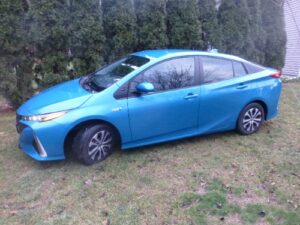
Prius Prime Rocks
Submitted by: David Rittenhouse
In late 2019, I decided getting a greener car would be a good idea. For many years I’ve been driving Honda Odysseys. They’ve been very reliable but get about 20 MPG. Most often, it was just me in the 8 passenger vehicle. I liked the idea of a PHEV that would use both gas and electricity. Over the years, I lost patience for unreliable cars. I rely on Consumer Reports for advice as they don’t accept advertising revenue and they poll their readers for feedback which they accumulate and publish in a monthly magazine and an easy to use website. Prius & Prius Prime have been on their Top Ten car lists for several years. I drove my 2019 Prius Prime for 3 years and 30,000 miles. Over that time I averaged over 80 MPG. In November 2022, I traded my base LE trim 2019 for the mid level XLE trim 2022. It’s nice having the power driver seat, more comfortable non fabric upholstery and a larger touch screen. The car comes with a 120v charging cable which charges the car in less than 6 hours. My house has the panel at the opposite end of the house so it’s nice not having to have an electrician run a 240v line. Bottom Line: Prius Prime is a reliable & reasonably inexpensive option that allows you the convenience of only home charging. On long road trips, you still get 54 MPG. And recently I was able to lay the seats down, insert an 8ft step ladder and close the hatchback. Seating for 5 now works just fine. Many days a week now I’m driving less than 25 miles and using no gasoline! Update after 9 months: Currently getting 90 MPG after 12,000 miles. Increase due to charging with electricity more often and using "CHARGE MODE" less. Charge Mode allows you to charge the battery to 80% while driving. When you plug in you charge to 100%.

Solar Energy – the Green Energy Solution
Submitted by: Paul Mammosser
I installed Solar power approximately 2 years ago and it definitely pays for itself. Federal and State incentives for Solar help reduce the overall cost of the solar system. Considering I consume ~ 12,000+ KWH per year and only pay ~ $120 after credits, that’s a big savings. The solar system pays for itself in 10 years or less and every month you get a credit from your electric provider for the power you provided back into the grid. Depending on your electric consumption and the size of your solar install, will determine your overall savings. All solar providers will help determine what you need and the potential savings. Solar is a good green energy solution and worth the investment.
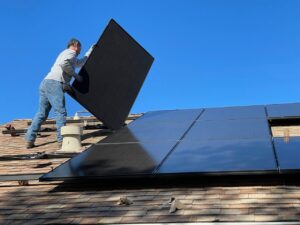
Solar Panel journey
Submitted by: Bo Kinney
I first inquired about solar panels when I had a MASS SAVE energy audit about 5 yrs ago. The woman told me after studying my house that my roof had too much shade and it wouldnt work. Oh well. Fast forward about 2 years and I had some trees taken down in my front yard because they were getting too close to my home. I didnt even think at the time that solar may now be an option.
Then a year or so later, Tom Emero a local salesman from Sunrun knocked on my door inquiring if I was interested in solar. I immediately began with all of the excuses to try and get rid of him. I first told him that MASS SAVE said I wasnt a good candidate. He said I was amazed because I had almost 100% sun and a solar system could meet over 90% of my energy needs. I then remebered that I had the trees taken down, but came up with my next excuse, I just had a new roof put on and didnt want to mess around with it, and he laughed and said we would want you to have a new roof. I ran out of excuses and agreed that he would provide me with a proposal.
He came back with a proposal for a 36 panel system that would meet almost all of my energy needs, and also that National Grid was offering a free Solar Battery. That was the kicker and we signed up for the PPA plan, basically renting. Cost me nothing and I got a free solar battery which replaced my aging generator, and also cut my energy bill by 1/3. And the fact that Sunrun owns the system, I never have to worry about maintenance. A month after install, a $4K piece of equipment was defective and it was replaced immediately for free. The system was a little smaller at 31 panels, because National Grid wants to still provide some energy, but they also get the right to buy energy from my solar battery in times of dire energy needs like a heat wave. Another excellent benefit of a solar battery is the more of them there are, National Grid has ways of meeting all of their customer needs in cases of emergency.
When I'm out walking my dog, I look for houses with good exposure and no panels and wonder why they havent signed up. It is a No Brainer.
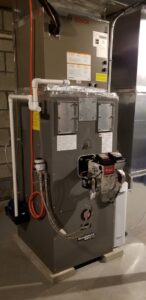
Reducing our oil heat carbon footprint
Submitted by: MarkandJennifer Minnichelli
My wife and I moved back to Franklin in 2016, purchasing a home with an oil-burner hot air heating system, with whole-house A/C sharing the same ducts. The house was built in 1986, so we realized that we would need to be replacing heating and cooling systems soon.
In 2019, it became time to update the systems. We looked at various options to reduce our carbon footprint. After evaluating various options, we decided to replace our oil-burning furnace with a dual-fuel oil burner/heat pump whole-house system. (If there was natural gas available on our street, we may have considered using natural gas as the heat pump dual fuel.) This system uses a Bosch air-source heat pump installed in-line with a new oil furnace, and using our existing ducting throughout the house. The system is controlled by a Bosch smart thermostat, which controls which heat source will be heating our home based on outdoor temperature and demand for heat. Generally, during most of spring and fall, when outdoor temperatures are above 35-40 F, the heat pump heats our home using only green electricity (supplied by our great, low-cost Franklin / Dynergy contract). When outdoor temperatures fall below 35F, our oil furnace kicks in to supply heat when the Bosch heat pump technology cannot. During summer cooling months, the heat pump provides energy-efficient air conditioning as well. The additional cost of installing the dual-fuel heat pump system was partially offset by Mass Save rebates of approximately $3500; Supreme Energy designed and installed the system, as well as helping us with the Mass Save rebates.
Although not as environmentally friendly as a full heat pump system would have been, the dual-fuel approach works well with our existing home, and helps us reduce our heating/cooling carbon footprint. We are always happy to hear the outdoor heat pump unit blowing air, whether during spring, summer, fall, or moderate winter days, knowing that our home is being heated or cooled using low-cost green, Dynergy-supplied electricity! (And also knowing that we are less subject to fossil fuel price increases!)

Solar offers a huge Bang for the Buck
Submitted by: David Rittenhouse
There are two major home projects required to make your home climate friendly: install solar panels and heat pumps. Solar panels offer a much bigger bang for the buck. With the 30% Federal tax credit and the $1000 Massachusetts State tax credit, my SGE Solar system will be paid for in 8 years. REC solar panels and Enphase microinverters carry a 25 year warranty. So that’s 17 years under warranty with free electricity. After my $8500 tax refund my initial $25,000 investment becomes $16,500 and my average $175 per month electric bill disappears. I still get an electric bill but now my monthly payment is zero. My panels face mostly East (not South which is optimal). They are also on the back of the house which is aesthetically appealing. Enphase has a wonderful app for your phone or website for your PC browser that allows you to track each panels production and verify their function. If one microinverter fails, the others are not impacted. If you have a singe SolarEdge inverter and it fails, all solar production is lost until it is repaired or replaced. Disclosure: Second Generation Energy made a $100 donation to be one of our 19 original Founders.

Listening to a podcast helps you engage in the climate conversation
Submitted by: Ted McIntyre
The topic of "Climate Change" can seem incomprehensible, inscrutable, bewildering and intimidating. It is so big and so varied that it can be tough to know where to start learning. I sometimes feel that way when it is time to do the dishes after I have cooked a big meal: “where should I start cleaning the mess??” But the solution is simple. I just pick up the first thing I see, and put it away, then the next thing to do is obvious.
It is the same principle in trying to engage with the climate movement. It matters less exactly where you start to engage, and matters more that you actually DO engage! One baby step is to listen to a podcast- it is easy and occasionally informative. Right now on Beacon Hill in Boston, there are new laws under consideration about how Massachusetts will act on climate. One proposal wants to 'make polluters pay.' What is up with that? Who is polluting? How much should they pay? Well, there is a 30 minute podcast available to answer that question, with an expert to explain the ideas in simple, straightforward and understandable ways. You can listen here.
The podcast episode is from a show The Climate Minute, which has been around for ten years. The show is dedicated to explaining the impacts and implications of global warming in easy to understand terms. Do you know what ISO is? Neither did anyone else until they listened to this show about "Demystifying FERC ISO NESCOE and NEPOOL.” Want to know how Franklin can become a Climate Leader Community? Listen to Cobi Frongillo explain.
You can listen to any or all the Climate Minute podcast episodes on Apple , Google: https://podcasts.google.com/search/the%20climate%20minute Podbean https://massclimateaction.podbean.com/ Or Spotify
If you are a fan of Franklin Matters, you can see the page that collects all the “Making Sense of Climate” episodes -> https://www.franklinmatters.org/2022/02/making-sense-of-climate-collection.html
But there are lots of other climate podcasts. A good one is Dave Robert's show Volts on Google. For a lighthearted take, go listen to Sustainababble (Spotify link)
So if you are not sure how to begin grappling with global warming, put 'climate change podcast' in your favorite search engine. You might enjoy what you hear.