
Testimonials
The testimonials below are sorted based on most recent submissions. If you want to look at testimonials about a specific topic, please refer to the testimonials under each action.

Eating local and supporting the community
Submitted by: Marissa Bovie
For the past couple of years, I've been trying to purchase more of my food from local sources. Not only are things fresher and taste better, but my food chain generates less CO2 when things don't have to travel as far to get to me. The Franklin Farmer's market has helped make that process easy, as there are a variety of vendors to buy from. Shopping there is a fun experience! Not everything is food, either. There's other local products as well, so I can get local soap, etc. While I still purchase some things from larger stores, I like being able to support others in the community and the chance to reduce my impact on the planet. Plus, it's delicious!
Solar panels pay off handsomely and wipe out CO2 emissions
Submitted by: Rand Barthel
My name is Rand and my wife, Carolyn, and I are members of the 350 Mass Greater Franklin Node that launched this website. We live in Mendon but have strong connections to Franklin because we have been attending church in Franklin for more than 20 years. Over the last decade we have systematically eliminated the major components of our carbon dioxide emissions, and saved a pile of money in the process. We are sharing our experience here because we think it is relevant to anyone undertaking a similar journey in Franklin.
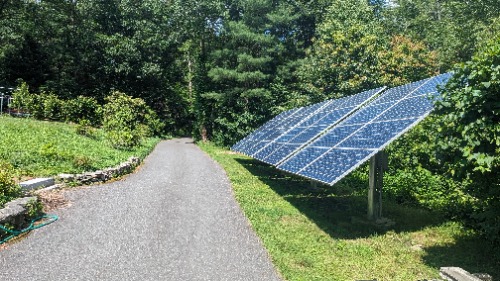
We considered solar panels in 2006 and got an estimate, but it was too expensive back then and the payback time would have been too long. In 2012 Carolyn co-led a town initiative called Solarize Mendon, aimed at making solar panels more affordable by bringing many buyers together for bulk purchasing and installation. By then better incentives were available from both Massachusetts and the Federal Government. In 2013, through Solarize Mendon we installed a ground-mounted array of 32 solar panels totaling 8 kW of capacity. We chose a ground-mount because of our house’s east-west orientation; the ground-mount faces due south. Each panel has its own microinverter to convert DC electricity to AC. That is more expensive than using one big inverter, but it enables the array to go on producing electricity even if some of its panels are shaded or not working. A buried conduit carries the electricity to the house, where it goes through a “net meter” that runs backward whenever the panels produce more electricity than the house is using.
This system went online in October 2013 and paid for itself in 2020. Since then it has generated a profit of about $13,000. It produces 7-8,000 kWh per year of free electricity. Some other basic parameters, and how they would be different today:
Purchase price: $47,500. This would be substantially less today, because panels are more efficient and cost less. An 8 kW system would need about 20 panels instead of 32. Also our ground mounted installation cost more than a rooftop installation would. Note that there is no Massachusetts sales tax on solar systems. According to the Massachusetts Clean Energy Center, the average cost of a roof-mount 8 kW solar system in 2023 is about $28,500 before tax credits and rebates.
Massachusetts tax credit: $2000. Today this is $1,000. See this Massachusetts Clean Energy Center table.
Federal tax credit: $14,560 in 2013. Today the federal tax credit of the purchase price is still 30%. If this exceeds your Federal tax liability in the year you install, you can carry the excess credit forward to future tax years.
Solar Renewable Energy Credits (SRECS): $23,000 as of 2022. This was a market-based incentive program whereby you earned a credit for every 1,000 kWh you produced. Utilities would purchase these credits to meet their obligation to obtain a certain percentage of their electricity supply from renewable sources (the so-called Renewable Portfolio Standard). This system has been replaced by the Solar Massachusetts Renewable Target (SMART) program, which pays you a more predictable monthly amount based on your production.
Production: 71,000 kWh 2013 through 2022, which would have cost us $21,000 to buy over that period. If you buy a solar system outright, expect about half of the return on investment to come from reduced or eliminated electricity bills, and half from the SMART program.
Payoff: 7 years.
Bottom line: If you are a homeowner planning to stay in your current home for more than about 7 years, solar panels are an excellent investment. Zillow estimates that homes with solar panels sell for about 4% more than homes without, all other things being equal.
My Solar Journey
Submitted by: Bipul Agarwal
I want to share a bit of my solar journey to encourage others to consider this option as well.
We had an existing A/C unit that worked quite well but generated higher electric bills every summer as it was not very efficient. It was also limited to the upper floors and did not cover the critical first floor where we spend most of our time. We also had two natural gas furnaces for heating.
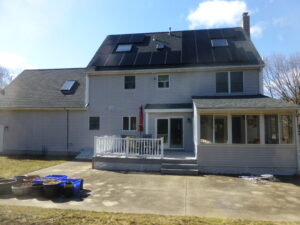
I had considered solar panels in the past but not seriously as my roof is facing east / west and is not considered optimal for solar generation. However, I was inspired by my neighbor to consider solar more earnestly as his roof has the same orientation and he had reported good results with his recent solar installation.
I used EnerySage to get quotes from multiple installers and also contacted a couple of local installers to get additional quotes. I ended up choosing Great Sky Solar in Arlington due to their strong reviews, in-house installation and service teams, and reasonable prices. I chose to get twenty 400W panels which is expected to provide about 120% of prior year's usage. I planned to simultaneously get two heat pumps to replace our aging A/C unit and to heat our home in the winter. My expectation was that the excess solar power and the much more efficient cooling units would cover much of my winter heating usage.
I signed the solar agreement in October 2022. National Grid approved the design in November 2022 and the town approved it in January 2023 after requesting a change. The panels were installed in March 2023 and our solar system became operational in April 2023 with a starting net meter value of 0 from National Grid.
I simultaneously replaced our old A/C and one old natural gas furnace with 2 heat pumps to provide both heating and cooling for our home. Our first floor did not have cooling earlier but now has a split unit to make summer days much more bearable.
Our meter reads less than 99000 after 4 months which means I have more than 1000KwH credit with National Grid. I expect the credit to cover a good amount of the higher electric usage by the heat pumps in the winter.
I am very pleased with my solar installation and would like to encourage fellow Franklin residents to consider this option to go green and also save money in the long term.
EV
Submitted by: kim barry
My Hyundai Ioniq is so much fun to drive! So glad I went electric.
Another great solar experience with SGE
Submitted by: Chris K
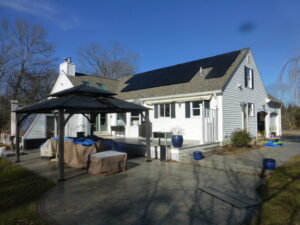
Fully recommend Dave Simmer and the team at SGE. I began the process of getting quotes from vendors and eventually choose SGE at the end of 2022. SGE's quote was by far the best value for the work I was looking for (28 panels on the entire side of my roof) even after getting quotes from 8 total vendors in the area. Dave provided me all the details I needed to make the best decision on which panel products to use, where to install them on my home and how to go about financing the project. I didn't feel pressured or inundated with emails (I did get this from other vendors). Dave was easily available to discuss adjustments in the project that I wanted to make and the team made things very easy to accommodate what I was looking for. I realize I was looking to buy solar panels at a very popular time, but SGE notified me and gave me dates when I would have the installation completed in early 2023. The installation team was attentive, friendly and clean (I have children and didn't find any left over pieces. They left my house like they found it). The electrician and crew kept me involved in the time frames for project completion and completing permits. The panels have been working great and I'm not worried since SGE has been available for questions since the project was completed. I completely recommend solar panels if it is in your budget, and will only recommend SGE Solar for any project you plan on doing.

Do You Know Where You’re Wasting Electricity?
Submitted by: David Rittenhouse
I use a dehumidifier in my basement. Because it uses a compressor, it uses significant electricity while running. I found this out by borrowing a Kill A Watt Monitor from the Franklin Public Library "Library of Things" collection. There are two major ways to use it: 1) Hit the "Watt" button to find out usage (in this case about 500 watts) when the unit is on; 2) use the KWH or killawatt hour button to see how much energy is used over time. The library lets you borrow this for 3 weeks. I ran my humidifier for 2 weeks and doubled the KWH to get a rough energy usage per month. I bought a new dehumidifier and will be saving electricity and using it year round now that it rarely needs to come on during the heating season to keep humidity at a healthy level below 60%. Please note that the Franklin Library only has a partial list on their website and at the time of writing did not include the TOOLS KILL A WATT MONITOR. My dehumidifier was 20+ years old. My next project will be to see how much electricity my 20+ year old refrigerator uses.